.svg)
2026 U.S. Multifamily Market Rankings
Investor caution around Sunbelt supply has obscured a more important signal: the structural demand fundamentals in many of these markets remain largely unchanged.
Stonewater Group evaluated more than 85 U.S. metropolitan areas to assess which markets carry durable structural advantages for multifamily investment, and which are benefiting from conditions unlikely to persist. The result is a risk-adjusted ranking framework built on z-score standardization across seven weighted pillars, validated through 1,000 Monte Carlo simulations per market. Markets that ranked highest demonstrated consistent strength across multiple dimensions simultaneously, rather than outperforming narrowly on any single indicator.
The Rankings: top markets for multifamily opportunity
Durable structural fundamentals define the leading markets
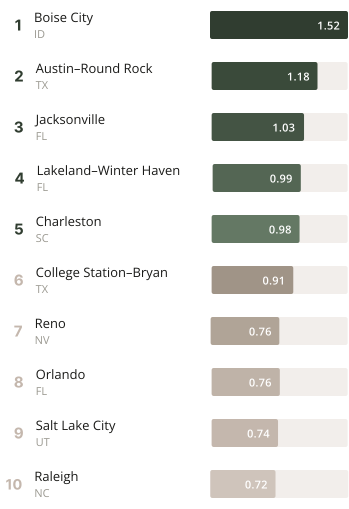
Each market is scored on a weighted composite z-score across seven independent pillars - a methodology that ranks markets by their overall risk-adjusted fundamentals rather than their performance on any single indicator. Markets that scored well on this basis did so by performing consistently across all seven dimensions, which tends to be a more reliable signal of long-run positioning than peak performance on one or two metrics. Boise leads the ranking with a composite z-score of 1.52, placing it more than one and a half standard deviations above the average market - a gap that reflects genuine breadth of advantage. Within the broader top ten, the investment implications vary by time horizon and deal type. Jacksonville and Charleston offer the most actionable near-term opportunities, with supply pipelines, feasibility scores, and absorption trends that support deployment within the next 12 months. Austin and Orlando carry more near-term supply pressure, but their economic and labor fundamentals rank among the strongest in the study - making them compelling targets for developers positioned to enter as pipeline absorption completes through 2026-2027.

A seven-pillar framework for market selection
Z-score standardization across seven independent dimensions
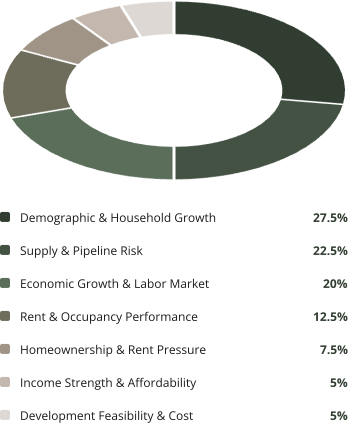
Each of the 85+ evaluated MSAs is scored across seven independent pillars, weighted to reflect their relative contribution to long-run multifamily performance. Demographic and household growth carries the highest weight at 27.5%, consistent with its role as the primary structural demand driver; supply and pipeline risk follows at 22.5%. Within each pillar, individual metrics - population growth rates, hard construction costs, absorption ratios - are normalized using z-scores, enabling direct comparison across indicators with different units and scales. Rankings were then validated through 1,000 Monte Carlo simulations per market, varying key inputs within realistic ranges to assess how reliably each market maintains its relative position under different assumptions.
Investment strategy: timing and approach by market
Structural rank and deployment timing are distinct considerations
Recommended Sunbelt markets share a broadly similar demand cycle: in-migration and employment growth generate rental demand, development activity accelerates, near-term rents and occupancy soften as new supply is absorbed, and fundamentals gradually retighten. A high composite ranking reflects the durability of a market's structural position through this cycle, though near-term deployment considerations vary by deal type and entry conditions.Over the 0–12 month horizon, Jacksonville presents the most compelling acquisition opportunity - a mid-tier pipeline ranking (#29 of 85+), a top-6 feasibility score, and improving absorption trends support near-term income. Charleston is the preferred ground-up market in this window, combining a top-2 feasibility ranking with a manageable supply pipeline and an employment base diversified across aerospace, port logistics, and healthcare.Over a 6–18 month horizon, Austin and Orlando are best approached opportunistically. Both rank among the top two markets on economic and labor fundamentals, and current pricing dislocation - a function of elevated near-term supply - provides a more attractive entry basis for investors with the patience to hold through absorption.Lakeland and Boise are suited to a phased scale-in approach, via builder site acquisitions and retail-to-multifamily conversions. Lakeland carries the strongest demographic score in the study; Boise combines a top-7 feasibility ranking with the highest structural confidence score across Monte Carlo simulations.
.svg)
Market deep dive: Charleston, SC
Charleston: diversified fundamentals support a leading ground-up development profile
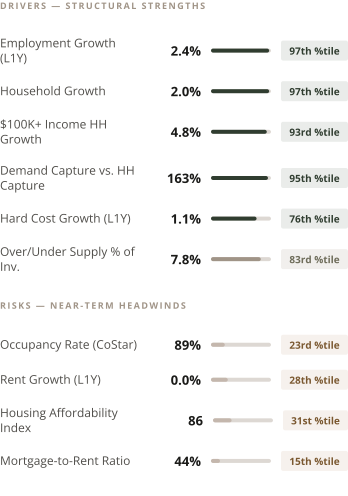
Charleston ranks fifth overall, with one of the most evenly distributed pillar profiles in the study. Its top-2 development feasibility ranking and top-15 supply risk score are supported by an employment base spanning aerospace, port logistics, and healthcare - sectors that collectively reduce long-run demand volatility relative to markets with narrower economic concentration.Near-term performance reflects a period of supply digestion rather than any deterioration in structural fundamentals. Occupancy has moderated and rent growth registered at 0.0% over the trailing year, an environment in which concession management and precise unit positioning will be important levers through 2025–2026. As the current supply cohort is absorbed, the supply-demand balance is expected to improve meaningfully by 2027, with rent growth anticipated to recover into the latter half of the decade.Construction costs, while easing from recent peaks, remain elevated in absolute terms, reinforcing the importance of basis discipline and phased delivery to project feasibility at today's rent levels.
Testing for structural strength: the Monte Carlo results
Assessing ranking stability across 1,000 simulated scenarios
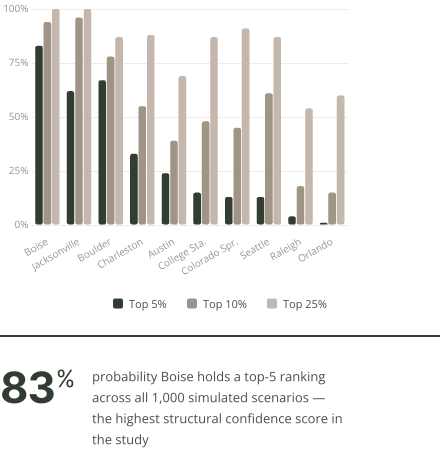
Each market's base-case ranking was subjected to 1,000 simulated scenarios, with key inputs - demographic growth, pipeline risk, labor market conditions, and rent performance - varied randomly within plausible ranges. The resulting probability distributions indicate how consistently each market retains a top-ranking position as assumptions shift. Boise and Jacksonville show the highest degree of ranking stability. Boise maintains a top-5 position in 83% of simulations, reflecting the breadth rather than the concentration of its structural advantages. Jacksonville achieves a 62% top-5 probability and a 96% top-10 probability - the highest top-10 confidence score in the study. Austin's 24% top-5 probability, relative to its #2 overall ranking, indicates meaningful sensitivity to supply-risk assumptions, which is consistent with its characterization as an opportunistic rather than core-market thesis.Taken together, the simulation results help distinguish markets where conviction can be held through the cycle from those where entry timing and deal structure carry greater weight.
Download the complete 2026 Market Rankings
The full report covers all 25 top-ranked MSAs with individual market narratives, complete pillar index breakdowns, Monte Carlo probability tables, and a five-stage implementation roadmap spanning market selection through execution.
.jpg)